
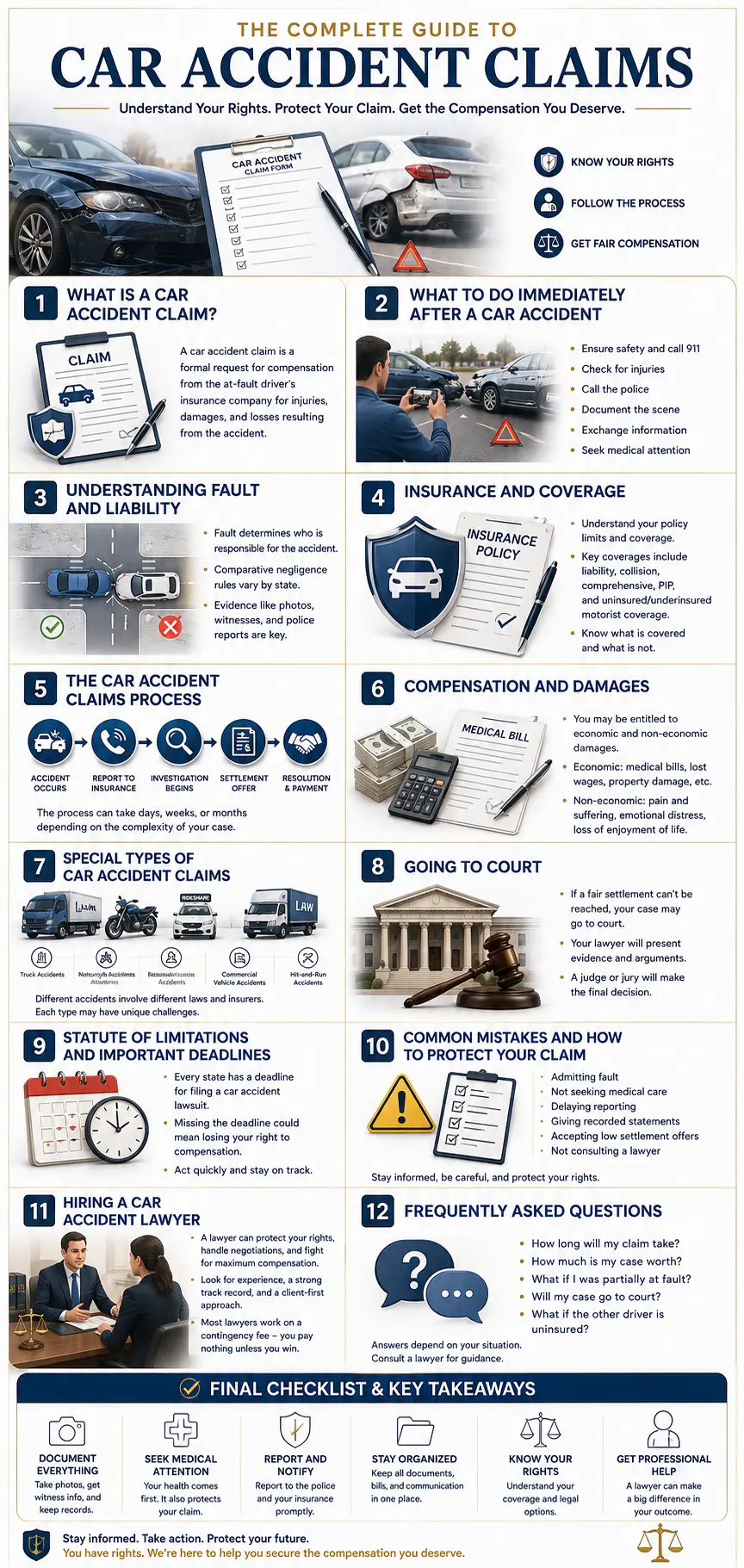
- 1.What Is a Car Accident Claim?
- 2.What to Do Immediately After a Car Accident
- 3.Understanding Fault and Liability
- 4.Insurance and Coverage
- 5.The Car Accident Claims Process
- 6.Compensation and Damages
- 7.Special Types of Car Accident Claims
- 8.Going to Court
- 9.Statute of Limitations and Important Deadlines
- 10.Common Mistakes and How to Protect Your Claim
- 11.Hiring a Car Accident Lawyer
- 12.Frequently Asked Questions
- 13.Final Checklist & Key Takeaways
A car accident can change your day in a matter of seconds. Along with dealing with injuries, vehicle damage, and medical appointments, you may also have to handle insurance companies, paperwork, and questions about your legal options. Knowing what to expect can make the process less stressful and help you make informed decisions.
This complete guide to car accident claims explains the key steps involved in filing an insurance claim after a car accident , understanding how a car accident claim works, what factors can affect a car accident settlement , and when it may be helpful to speak with a car accident lawyer. You'll also learn how accident compensation is calculated, what mistakes to avoid, and why state laws can affect your claim.
The information in this guide is based on generally accepted U.S. personal injury principles, common insurance practices, and guidance from organizations such as the National Highway Traffic Safety Administration . Because car accident laws vary by state, some legal rules and filing requirements may differ depending on where the accident occurred.
Whether you're beginning the claims process or simply looking for reliable information, this guide provides a clear, practical overview of what you need to know.
Whether you're beginning the claims process or simply looking for reliable information, this guide provides a clear, practical overview of what you need to know.
What Is a Car Accident Claim?
A car accident claim is a formal request for payment after a motor vehicle accident causes injuries, property damage, or other financial losses. Most claims begin with an insurance company, but some may later involve a lawsuit if the parties cannot reach an agreement. The purpose of a claim is to recover money for losses that resulted from the accident, not to punish the person who caused it.
Many states require drivers to report accidents involving injuries, fatalities, or significant property damage. Some states also require drivers to file an accident report with their State Department of Motor Vehicles (DMV). Reporting requirements and deadlines vary by state.
Insurance requirements and claims rules are governed by state law, so the claims process and available benefits may differ depending on where the accident occurred.
Common Types of Car Accident Claims
Not every claim involves the same type of damage. A single accident may result in multiple claims, including:
- Personal injury claims for medical expenses, lost income, and other injury-related losses.
- Property damage claims to repair or replace a damaged vehicle and other personal property.
- Uninsured or underinsured motorist claims when the at-fault driver has little or no insurance coverage.
- Medical payments or Personal Injury Protection (PIP) claims in states where these coverages apply.
Understanding which type of claim applies is an important first step because each may have different documentation requirements and deadlines.
How a Car Accident Claim Works
Although the details vary, most claims follow a similar process:
- Report the accident to the insurance company.
- Gather evidence, such as photographs, medical records, repair estimates, and witness information.
- The insurance company investigates the accident and reviews the available evidence.
- Liability and damages are evaluated.
- The insurer may approve, deny, or negotiate the claim.
- If an agreement is reached, the claim is resolved through a settlement. If not, some cases proceed to court.
For example, suppose Driver A runs a red light and collides with Driver B. Driver B suffers a broken wrist and their vehicle requires extensive repairs. After reporting the accident and providing supporting evidence, Driver B files an insurance claim seeking payment for medical bills, repair costs, and other covered losses. The insurance company investigates before deciding whether to offer a settlement.
Why Understanding the Claims Process Matters.
Learning how a car accident claim works can help you keep organized records, communicate more effectively with insurance adjusters, and avoid common mistakes that could delay the process. It also helps you recognize when a claim becomes more complex, such as disputes over fault, serious injuries, or multiple parties.
While many claims are resolved through insurance negotiations, some situations may require guidance from a car accident lawyer, especially when liability is disputed, damages are significant, or state-specific legal issues arise. Because insurance laws and filing deadlines differ across the United States, it is important to understand the rules that apply where the accident occurred.
What to Do Immediately After a Car Accident
The actions you take in the minutes and hours after a car accident can affect your health, your insurance claim, and the evidence available to support your claim later. While every accident is different, following a clear plan can help you stay organized and reduce unnecessary complications.
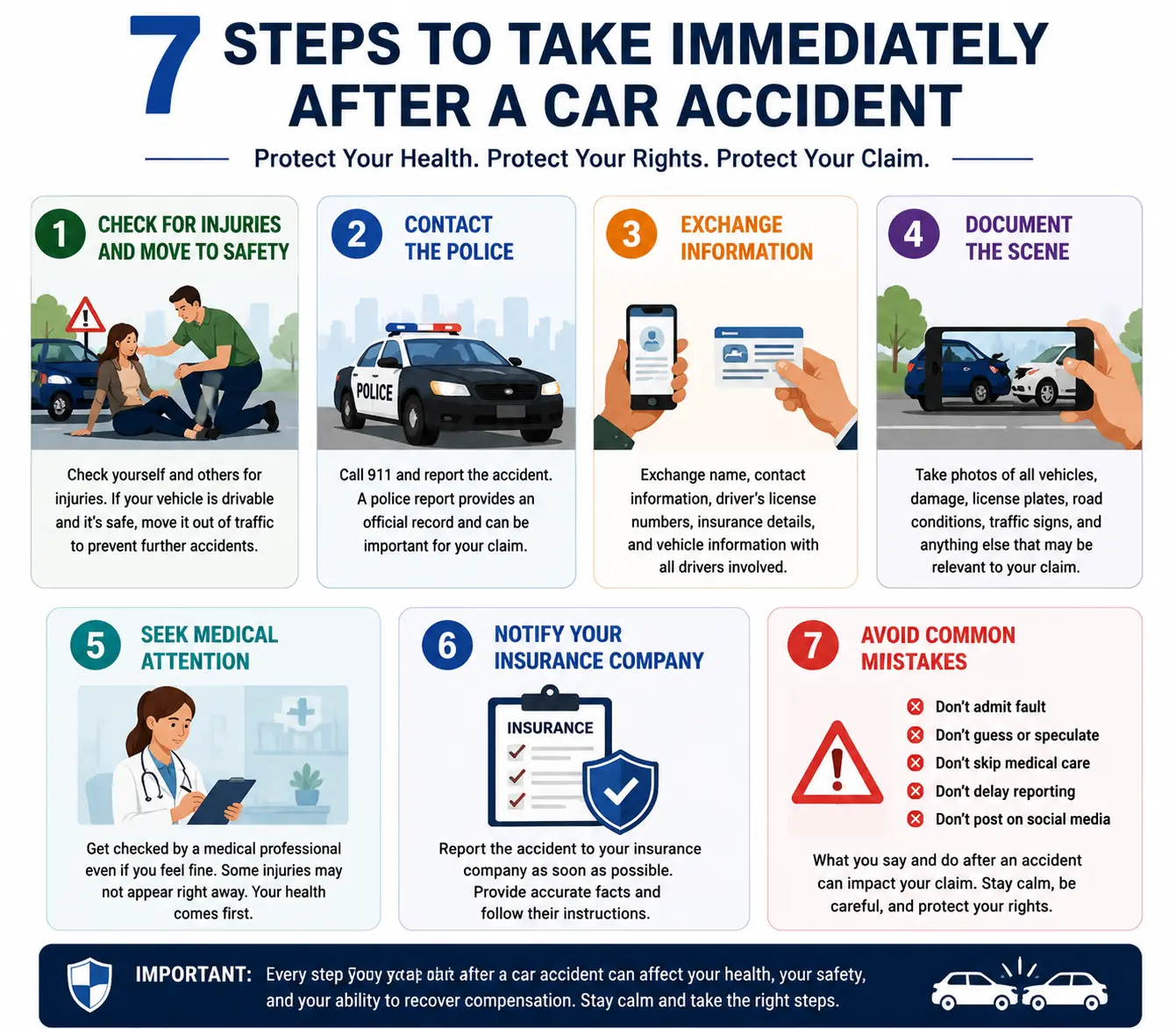
1. Check for Injuries and Move to Safety
Your first priority is safety. Check yourself and others for injuries. If anyone appears seriously hurt, call 911 immediately and avoid moving injured people unless there is an immediate danger, such as a fire or oncoming traffic.
If the vehicles can be moved safely and doing so is permitted, relocate them to the shoulder or another safe area to reduce the risk of another collision.
2. Contact the Police
Many states require drivers to report accidents involving injuries, fatalities, or significant property damage. Even when reporting is not legally required, requesting a police officer can be helpful because an official accident report often becomes important evidence during the claims process.
When speaking with law enforcement, provide accurate facts about what happened. If you are unsure about a detail, say so rather than guessing.
3. Exchange Information
Collect basic information from everyone involved in the accident, including:
- Name and contact information
- Driver's license number
- Insurance company and policy number
- Vehicle make, model, and license plate number
If there are witnesses, politely ask for their names and phone numbers. Independent witness statements can be valuable if there is later disagreement about how the accident occurred.
4. Document the Scene
Photographs and videos can preserve important details before vehicles are moved or conditions change.
Try to capture:
- Vehicle damage from multiple angles
- The overall accident scene
- Road conditions
- Traffic signs and signals
- Skid marks or debris
- Visible injuries, if appropriate
You may also want to record the date, time, weather conditions, and anything you remember about how the collision happened while the details are still fresh.
5. Seek Medical Attention
Some injuries, including whiplash and concussions, may not cause noticeable symptoms immediately after a crash. If you have pain, symptoms, or concerns about a possible injury, seek medical attention promptly.
A medical evaluation can help identify injuries and create a record of your condition after the accident. Medical records may also help establish a timeline between the accident and any injuries you report later. Delaying medical evaluation can make it more difficult to document when symptoms began.
Keep copies of medical records, bills, prescriptions, and other documents related to treatment. These records may become important when evaluating injury-related losses as part of an insurance claim.
6. Notify Your Insurance Company
Most insurance policies require policyholders to report accidents promptly. When contacting your insurer, provide factual information about the collision and cooperate with reasonable requests for documentation.
If the other driver's insurance company contacts you, ask what information it is requesting and why a statement is needed before agreeing to provide a recorded statement. Keep copies of your communications and any documents you provide to the insurer.
7. Avoid Common Mistakes
In the hours after an accident, small decisions can have lasting consequences. To help protect your interests:
- Do not admit fault at the scene.
- Do not speculate about what caused the accident.
- Do not post details or photographs of the crash on social media.
- Keep copies of medical bills, repair estimates, receipts, and correspondence with insurance companies.
- Write down important dates and conversations in a dedicated file or notebook.
Practical Example
Imagine another driver rear-ends your vehicle at a stoplight. You call 911, exchange insurance information, photograph both vehicles, obtain contact information from a nearby witness, visit an urgent care clinic later that day for neck pain, and report the accident to your insurer that evening. These steps create a clear record that can make the claims process more straightforward if questions arise later.
Quick Checklist
✓ Check for injuries and call 911 if needed
✓ Move to a safe location when possible
✓ Contact the police
✓ Exchange driver and insurance information
✓ Take photos and videos of the accident scene
✓ Collect witness contact information
✓ Get medical care promptly
✓ Report the accident to your insurance company
✓ Keep all accident-related records and receipts
Understanding Fault and Liability
After reporting an accident and gathering evidence, the next step is determining who may be legally responsible for the crash. This is known as establishing fault or liability . The determination can significantly affect how an insurance company evaluates a claim and whether compensation may be available.
Although the basic principles are similar across the United States, the rules for determining liability vary by state. Understanding these differences can help you better understand how insurance companies and courts evaluate accident claims.
What Is Fault?
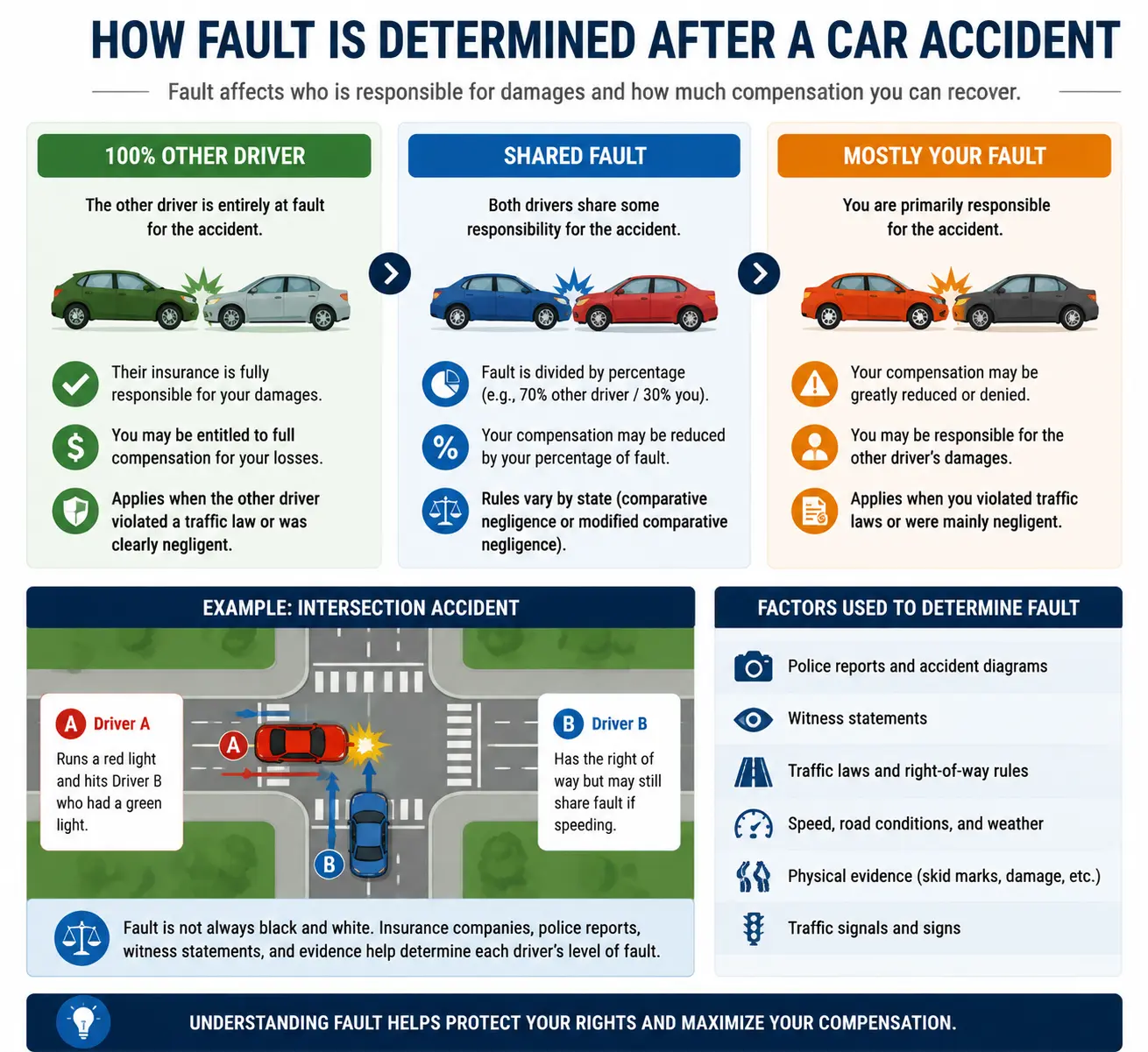
Fault refers to responsibility for causing or contributing to a motor vehicle accident. Insurance companies investigate collisions to determine whether one driver, multiple drivers, or another party may have contributed to what happened.
To evaluate fault, insurers may review:
- Police accident reports
- Photographs and videos
- Witness statements
- Vehicle damage
- Traffic camera footage
- Medical records
- Statements from the drivers involved
No single piece of evidence automatically determines fault. Instead, insurers generally evaluate the available information as a whole.
Common Causes of Driver Liability
Many accidents occur because a driver fails to exercise reasonable care. Some common examples include:
- Distracted driving
- Speeding
- Running red lights or stop signs
- Following another vehicle too closely
- Failing to yield the right of way
- Driving under the influence of alcohol or drugs
- Unsafe lane changes
If one of these actions contributes to an accident, that driver may be held liable for resulting damages, depending on the circumstances and applicable state law.
When More Than One Driver Shares Fault
Not every collision has a single responsible party. In some accidents, both drivers contribute to what happened.
For example, Driver A is speeding through an intersection while Driver B makes an unsafe left turn. Investigators may conclude that both drivers share responsibility because each driver's actions contributed to the collision.
Many states recognize shared responsibility through comparative or contributory negligence rules.
| Liability Rule | How It Works |
| Pure Comparative Negligence | A person may recover damages even if they were mostly at fault, although their compensation is reduced by their percentage of responsibility. |
| Modified Comparative Negligence | A person can recover damages only if their share of fault stays below a state-established threshold, which is often 50% or 51%. |
| Contributory Negligence | A small number of states prevent recovery if the injured person contributed to the accident, even to a limited extent. |
Because these rules differ by state, the outcome of a claim can vary depending on where the accident occurred.
Can Someone Other Than a Driver Be Liable?
Yes. In some situations, responsibility extends beyond the drivers involved.
Examples include:
- A vehicle manufacturer if a defective part contributed to the crash.
- A trucking company responsible for its employee's actions.
- A government agency that failed to maintain a hazardous roadway, where state law allows such claims.
- An employer when an employee causes an accident while performing work duties.
Determining liability in these situations often requires additional investigation and supporting evidence.
Why Liability Matters
Liability can influence whether compensation is available and how much may ultimately be recovered. If fault is disputed, the claims process may take longer because insurers need to review additional evidence before reaching a decision.
For instance, imagine two drivers disagree about who had the green light at an intersection. If nearby traffic camera footage supports one driver's version of events, that evidence may play an important role in resolving the dispute. This illustrates why preserving evidence after an accident is so important, as discussed in the previous section.
If liability remains unclear or several parties may share responsibility, consulting a car accident lawyer may help you understand how your state's laws apply and what additional evidence may be relevant to your claim.
Insurance and Coverage
Once fault and liability have been evaluated, the next question is often: Which insurance policy may pay for the damages? The answer depends on the type of coverage available, the laws of the state where the accident occurred, and the details of the crash.
Auto insurance policies can include several types of coverage, and understanding the differences can make the claims process easier to follow.
The insurance terms used in this guide follow commonly accepted industry definitions, including educational resources published by the Insurance Information Institute (III) . However, policy language and coverage requirements may vary by insurer and state.
Common Types of Auto Insurance Coverage
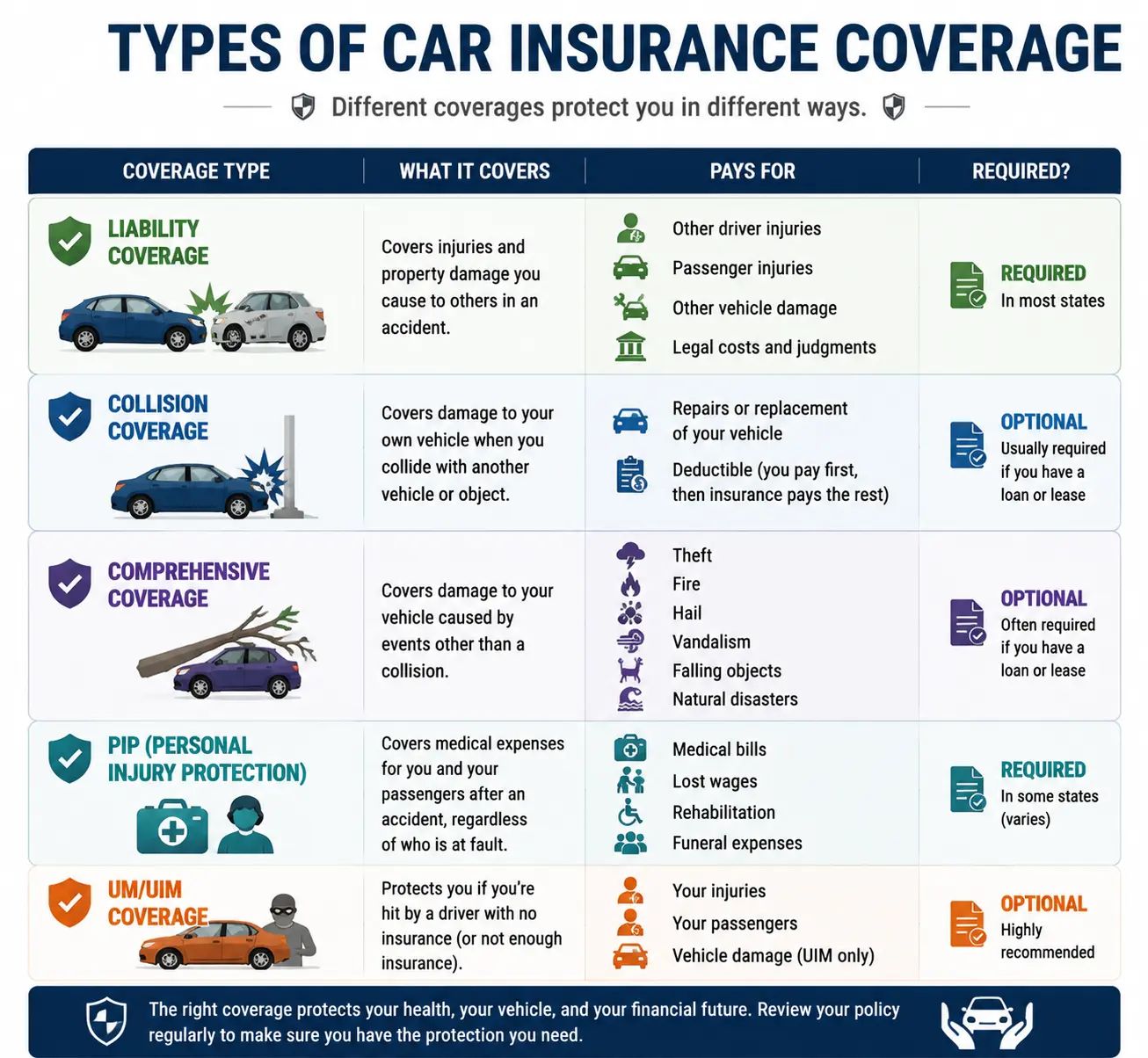
The table below explains common forms of coverage found in U.S. auto insurance policies.
| Coverage Type | What It May Pay For |
|---|---|
| Liability Coverage | Injuries and property damage caused to others when the policyholder is legally responsible. |
| Collision Coverage | Damage to the policyholder's vehicle resulting from a collision, subject to the policy terms and deductible. |
| Comprehensive Coverage | Certain non-collision losses, such as theft, vandalism, hail, or falling objects. |
| Personal Injury Protection (PIP) | Medical expenses and certain other costs covered by the policy, regardless of who caused the accident, where PIP applies. |
| Medical Payments Coverage (MedPay) | Certain medical expenses for covered drivers and passengers, subject to the policy terms. |
| Uninsured Motorist (UM) Coverage | Certain losses caused by a driver who does not have required insurance, subject to the policy terms. |
| Underinsured Motorist (UIM) Coverage | Certain losses when the at-fault driver's available insurance is insufficient to cover the covered losses, subject to the policy terms. |
Not all states require the same coverage, and policy limits, deductibles, exclusions, and other terms can vary significantly.
Fault States vs. No-Fault States
Insurance claims are handled differently depending on state law.
In fault states , the driver who caused the accident is generally responsible for damages. Injured parties may file claims against the at-fault driver's insurance company, subject to applicable law and policy limits.
In no-fault states , drivers generally turn first to their own Personal Injury Protection (PIP) coverage for covered medical expenses and certain other losses, regardless of who caused the crash. Some no-fault states limit when an injured person can pursue a claim against the at-fault driver for additional damages.
Because these rules differ, understanding your state's insurance system is an important part of evaluating a claim.
Policy Limits Matter
Insurance coverage is not unlimited. Every policy has limits that can cap how much an insurer may pay for covered losses.
For example, a liability policy with limits of $50,000 per person and $100,000 per accident may not fully cover severe injuries involving multiple people. In these situations, additional sources of coverage, such as underinsured motorist benefits, may become important.
What Happens When the Other Driver Has No Insurance?
Despite state insurance requirements, some drivers remain uninsured.
If an uninsured driver causes a crash, coverage may come from:
- Uninsured motorist coverage
- Collision coverage for vehicle repairs
- Personal Injury Protection or MedPay, where available
- Other applicable insurance policies
Reviewing your own policy after an accident can help identify potential sources of coverage.
Understanding Deductibles
Certain coverages, such as collision and comprehensive insurance, often include deductibles. A deductible is the amount the policyholder generally pays toward a covered loss before the insurer pays the remaining covered amount, subject to the policy terms.
For example:
- Repair cost: $4,000
- Collision deductible: $500
- Insurance payment: $3,500
Liability claims against another driver's insurance generally do not involve the injured person's own collision or comprehensive deductible.
Practical Example
Suppose Driver A causes an accident that injures Driver B and damages Driver B's vehicle. Driver A's liability insurance may cover Driver B's covered losses, up to the applicable policy limits. If Driver A has insufficient coverage, Driver B's underinsured motorist coverage may provide additional protection if that coverage applies.
Understanding insurance coverage helps explain why two accidents with similar facts may lead to different financial outcomes. The next step is learning how to file and support an insurance claim after a car accident.
The Car Accident Claims Process
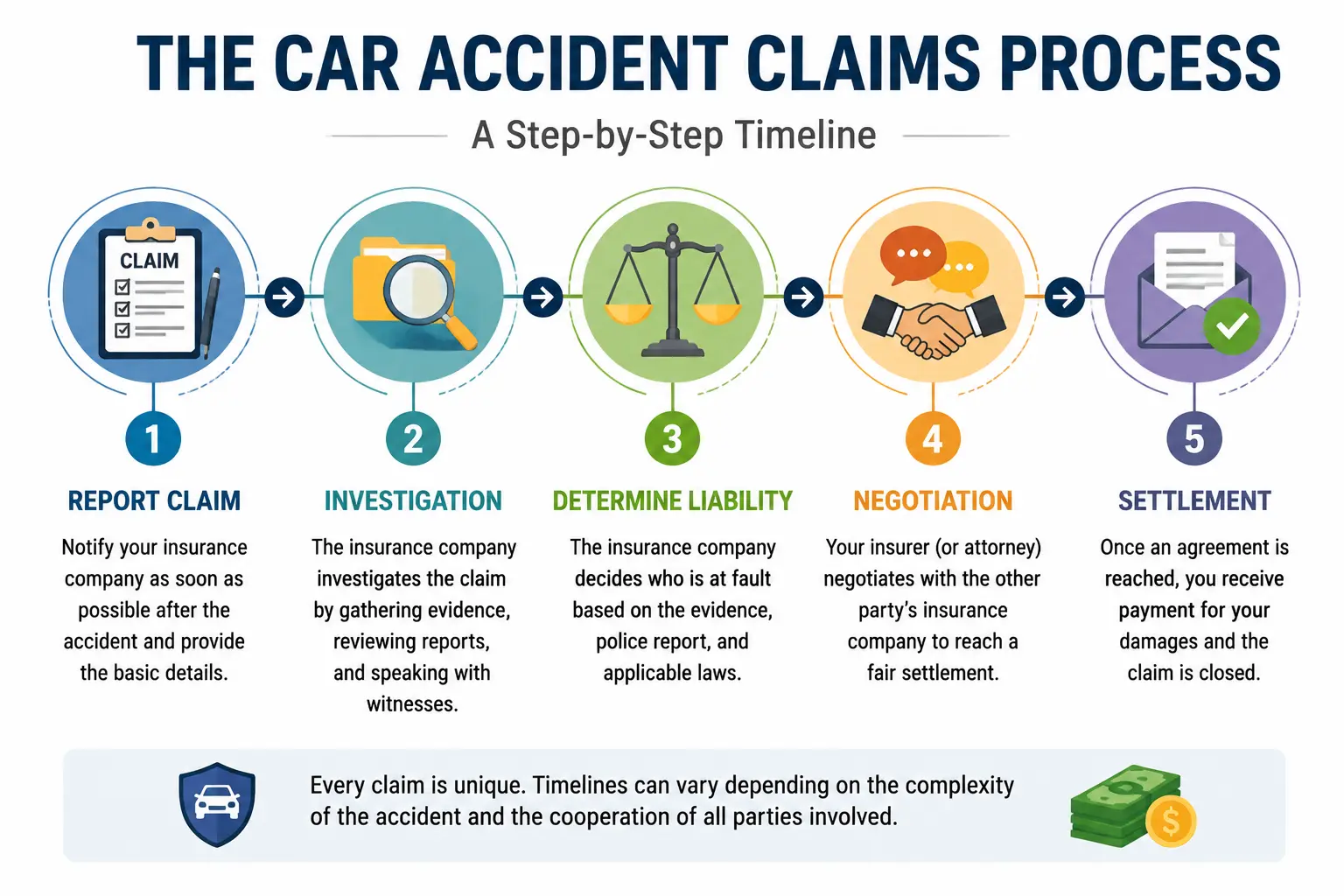
After understanding how insurance coverage works, the next step is learning how a car accident claim typically moves from the initial report to a final resolution. While the exact process varies by insurer, policy, and state law, many claims follow a similar sequence.
Step 1: Report the Accident
The claims process usually begins when the accident is reported to the appropriate insurance company. During this stage, the insurer creates a claim file and assigns a claims adjuster to investigate the incident.
Be prepared to provide basic information, including:
- Date, time, and location of the accident
- Names of the drivers involved
- Insurance policy information
- Police report number, if available
- Photos and other supporting evidence
Providing accurate and complete information early can help prevent unnecessary delays.
Step 2: Investigation
Once the claim is opened, the insurance company investigates the accident to determine what happened and whether the claimed losses are covered under the applicable policy.
The adjuster may review:
- Police reports
- Photographs and videos
- Witness statements
- Vehicle repair estimates
- Medical records
- Insurance policy documents
- Available surveillance or traffic camera footage
Depending on the complexity of the accident, this stage may take days or several weeks.
Step 3: Determining Liability and Damages
After reviewing the available evidence, the insurer evaluates who may be responsible for the accident and assesses the claimed damages.
This evaluation may include:
- Medical expenses
- Lost wages
- Vehicle repair or replacement costs
- Rental car expenses, if covered
- Other documented losses allowed under applicable law or the insurance policy
If additional information is needed, the insurer may request further documentation before making a decision.
Step 4: Settlement Negotiations
If the insurer accepts liability, it may make a settlement offer.
Before accepting an offer, review it carefully to determine whether it addresses the losses covered by the claim. In some cases, additional documentation or negotiation may result in a revised offer.
Claims involving serious injuries, disputed fault, or substantial financial losses often require more extensive negotiations than straightforward property damage claims.
Step 5: Claim Resolution
Many claims end with a negotiated settlement. Once a settlement agreement is finalized and any required documents are signed, payment is generally issued according to the agreement.
If the parties cannot reach an acceptable resolution, other options may be available, including mediation, arbitration, or filing a lawsuit where permitted by state law. The availability and use of these options vary depending on the circumstances, insurance policy, and applicable law.
Estimated Claim Timeline
| Stage | Typical Activities |
|---|---|
| Claim Reporting | Notify the insurer and submit initial information. |
| Investigation | Review evidence and determine coverage. |
| Liability Review | Evaluate fault and damages. |
| Negotiation | Discuss and review settlement offers. |
| Resolution | Settle the claim or consider further legal action. |
There is no universal timeline for resolving a claim. A minor property damage claim may conclude relatively quickly, while claims involving severe injuries, multiple vehicles, or disputed liability can take considerably longer.
Keeping organized records, responding promptly to reasonable requests, and maintaining copies of claim-related documents can help you stay organized throughout the process. If significant disagreements arise regarding liability or compensation, consulting a car accident lawyer may help you understand your legal options under your state's laws.
Compensation and Damages
After liability has been evaluated and the claims process is underway, the next question is often how much compensation may be available. In a car accident claim, damages refer to the financial value assigned to losses caused by the accident. The goal of damages is generally to compensate an injured person for covered losses resulting from the crash.
The amount of accident compensation depends on the facts of the case, the available evidence, applicable state laws, and the insurance coverage involved.
Economic Damages
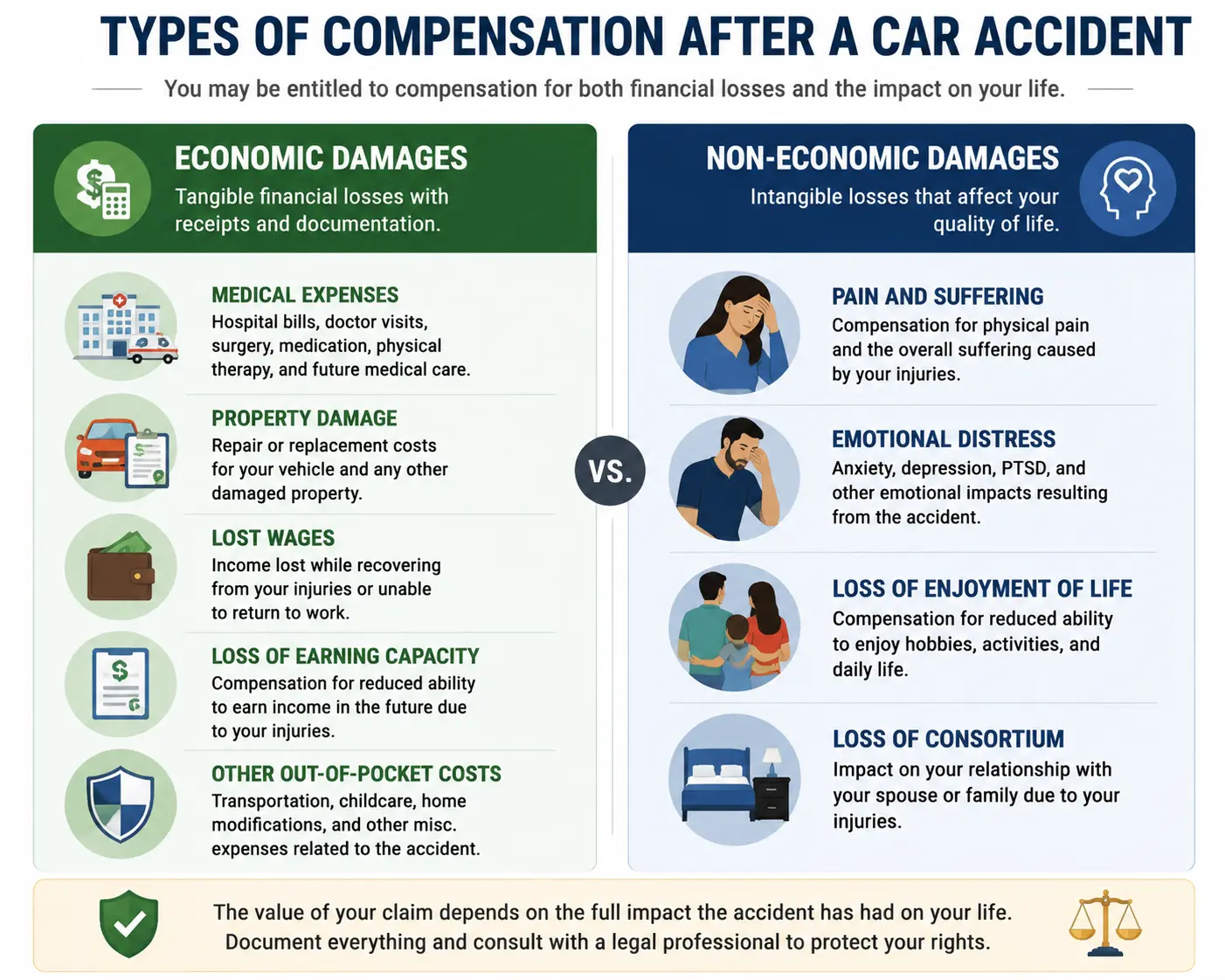
Economic damages are losses that can usually be measured using bills, receipts, invoices, or other financial records.
These may include:
- Medical expenses, including emergency care, surgery, rehabilitation, and prescription medications
- Future medical treatment related to the injury
- Lost wages while recovering
- Reduced earning capacity if injuries affect future employment
- Vehicle repair or replacement costs
- Rental vehicle expenses, when applicable
- Other documented out-of-pocket expenses related to the accident
Keeping organized records is important because insurers generally require documentation to evaluate these losses.
Non-Economic Damages
Some losses do not come with a receipt but can still have a significant impact on daily life.
Depending on state law and the circumstances of the claim, non-economic damages may include:
- Physical pain
- Emotional distress
- Mental anguish
- Loss of enjoyment of life
- Permanent disability or disfigurement
- Loss of companionship in certain qualifying cases
These damages can be more difficult to calculate because they involve the personal effects of an injury rather than direct financial costs.
Can Punitive Damages Apply?
In a small percentage of cases, courts may award punitive damages . Unlike compensatory damages, these damages are generally intended to punish particularly reckless or intentional misconduct rather than compensate for actual losses.
Examples may include conduct involving extreme intoxication or other especially dangerous behavior. However, punitive damages are not available in every state and are awarded only when applicable legal standards are met.
Factors That Can Affect Compensation
Several factors can influence the value of a car accident claim, including:
- The severity of the injuries
- Length of medical treatment
- Whether long-term care is required
- Amount of lost income
- Degree of fault assigned to each party
- Available insurance policy limits
- Strength of the supporting evidence
- Applicable state laws
Even two accidents involving similar injuries may result in different outcomes because these factors vary from case to case.
Example
Assume a driver suffers a fractured leg in a collision caused by another motorist. The injured driver incurs hospital bills, misses three months of work, requires physical therapy, and experiences ongoing pain during recovery. A settlement evaluation may consider medical expenses, lost income, future treatment costs, pain and suffering where permitted, and property damage, subject to applicable insurance coverage and state law.
Tips for Documenting Your Losses
To support a compensation claim, consider maintaining copies of:
- Medical bills and treatment records
- Pharmacy receipts
- Pay stubs showing lost income
- Vehicle repair estimates
- Rental car invoices
- Travel expenses for medical appointments
- A journal describing pain, recovery, and daily limitations
Well-organized documentation can make it easier to demonstrate how the accident affected your finances and everyday life.
Understanding the different categories of damages is an important step toward evaluating a settlement offer. The following sections explain other factors that can affect a car accident claim and the legal issues that may arise in more complicated cases.
Special Types of Car Accident Claims
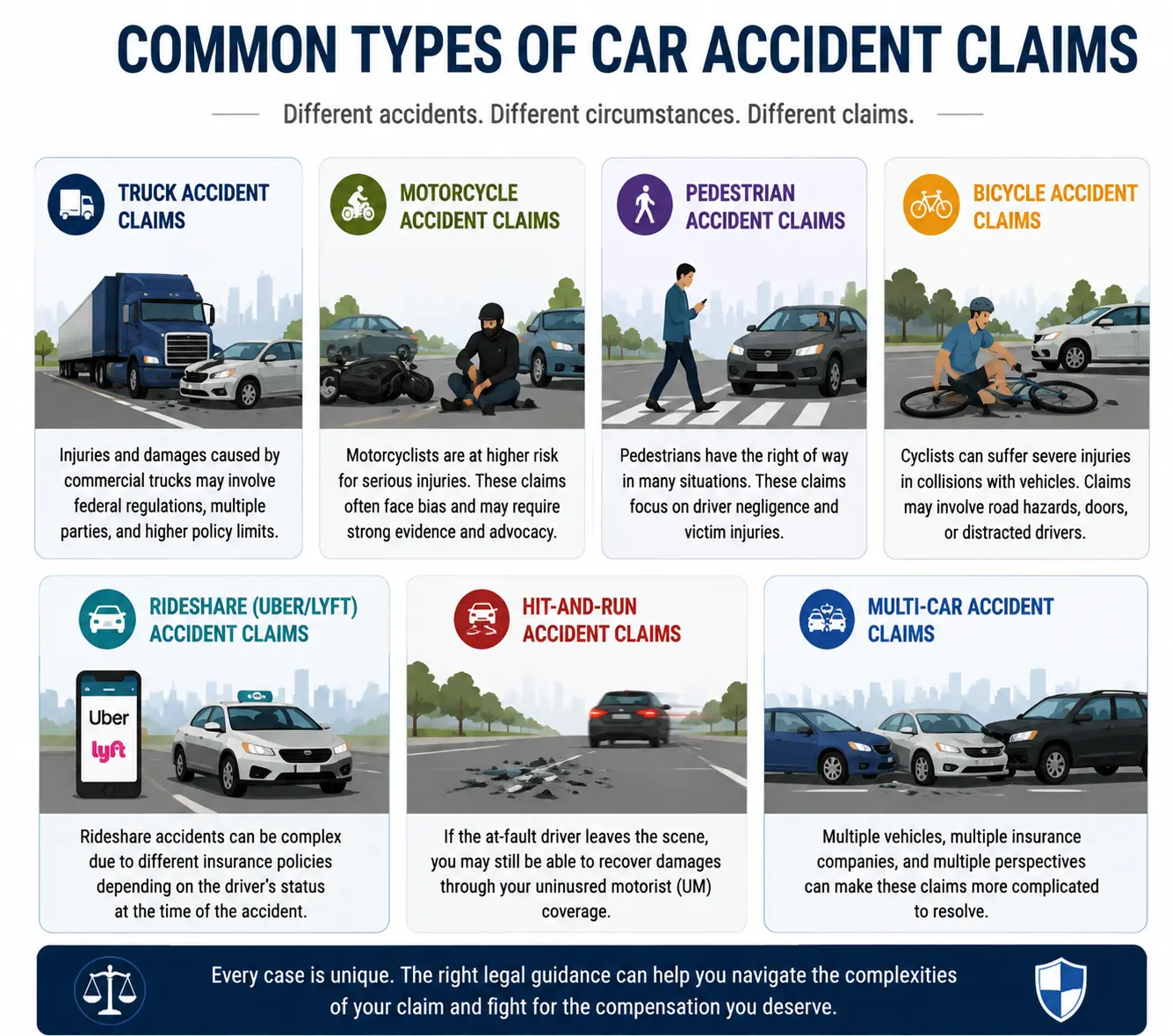
Not every car accident claim follows the same pattern. While many claims involve two passenger vehicles and a straightforward insurance process, others present additional legal or insurance issues. The type of accident, the parties involved, and applicable state and federal laws can all affect how a claim is handled.
Understanding these situations can help you recognize when additional evidence or legal guidance may be needed.
Claims Involving Commercial Trucks
Accidents involving large commercial trucks can be more complex than standard vehicle collisions.
In addition to the truck driver, other parties may potentially share responsibility, including:
- The trucking company
- A maintenance contractor
- A company responsible for loading cargo
- The manufacturer of a defective truck part
These claims may also involve federal trucking regulations, driver records, maintenance records, and electronic data that are not typically part of ordinary car accident claims.
Motorcycle Accident Claims
Motorcycle accidents can result in serious injuries because riders have less physical protection than occupants of passenger vehicles.
Insurance companies may examine issues such as:
- Helmet use
- Visibility
- Lane positioning
- Speed
- Right-of-way
Although the claims process may be similar to that for other vehicle accidents, the severity of injuries and questions about how the crash occurred can make these cases more complex.
Pedestrian and Bicycle Accident Claims
When a vehicle strikes a pedestrian or cyclist, the resulting injuries can be severe even at relatively low speeds.
Evidence may include:
- Traffic signal timing
- Crosswalk markings
- Surveillance footage
- Witness statements
- Vehicle speed data, when available
Depending on state law and the circumstances of the accident, the actions of both the driver and the pedestrian or cyclist may be considered when determining liability.
Hit-and-Run Accidents
A hit-and-run occurs when a driver involved in an accident leaves the scene without providing required information or assistance.
If the responsible driver cannot be identified, potential sources of compensation may include:
- Uninsured motorist coverage
- Personal Injury Protection (PIP), where applicable
- Medical Payments coverage
- Other available insurance benefits
Promptly reporting the accident to law enforcement and your insurance company is especially important in these cases.
Accidents Involving Uninsured or Underinsured Drivers
Even when the at-fault driver remains at the scene, they may not have enough insurance to cover all of the resulting damages.
In these situations, a claim may involve multiple insurance policies, including your own uninsured or underinsured motorist coverage if it is available under your policy and applicable state law.
Multi-Vehicle Accidents
Chain-reaction crashes involving three or more vehicles can make determining liability more difficult.
Insurance companies may investigate:
- The sequence of impacts
- Following distances
- Road conditions
- Driver reactions
- Independent witness accounts
Multiple insurers may participate in resolving these claims, which can increase the time needed for investigation.
Accidents Caused by Defective Vehicles
Sometimes a crash results from a defective vehicle component rather than driver error alone.
Examples include:
- Brake failure
- Tire defects
- Steering system failures
- Airbag malfunctions
If a defective vehicle part may have contributed to the accident, vehicle recall information published by the National Highway Traffic Safety Administration (NHTSA) can help determine whether the vehicle or component was subject to a safety recall.
These situations may involve product liability claims against vehicle or parts manufacturers in addition to traditional auto insurance claims.
Practical Example
Imagine a delivery truck collides with two passenger vehicles after its brakes fail. Investigators may examine whether the driver acted negligently, whether the trucking company properly maintained the vehicle, and whether a defective brake component contributed to the crash. Instead of involving only one insurance policy, several insurers and potentially multiple responsible parties may become involved in the claims process.
Because these specialized claims often involve additional evidence, multiple parties, or unique legal rules, they may require more extensive investigation than a typical two-vehicle collision. Understanding the type of claim involved can help identify the evidence and insurance coverage that may apply.
Going to Court
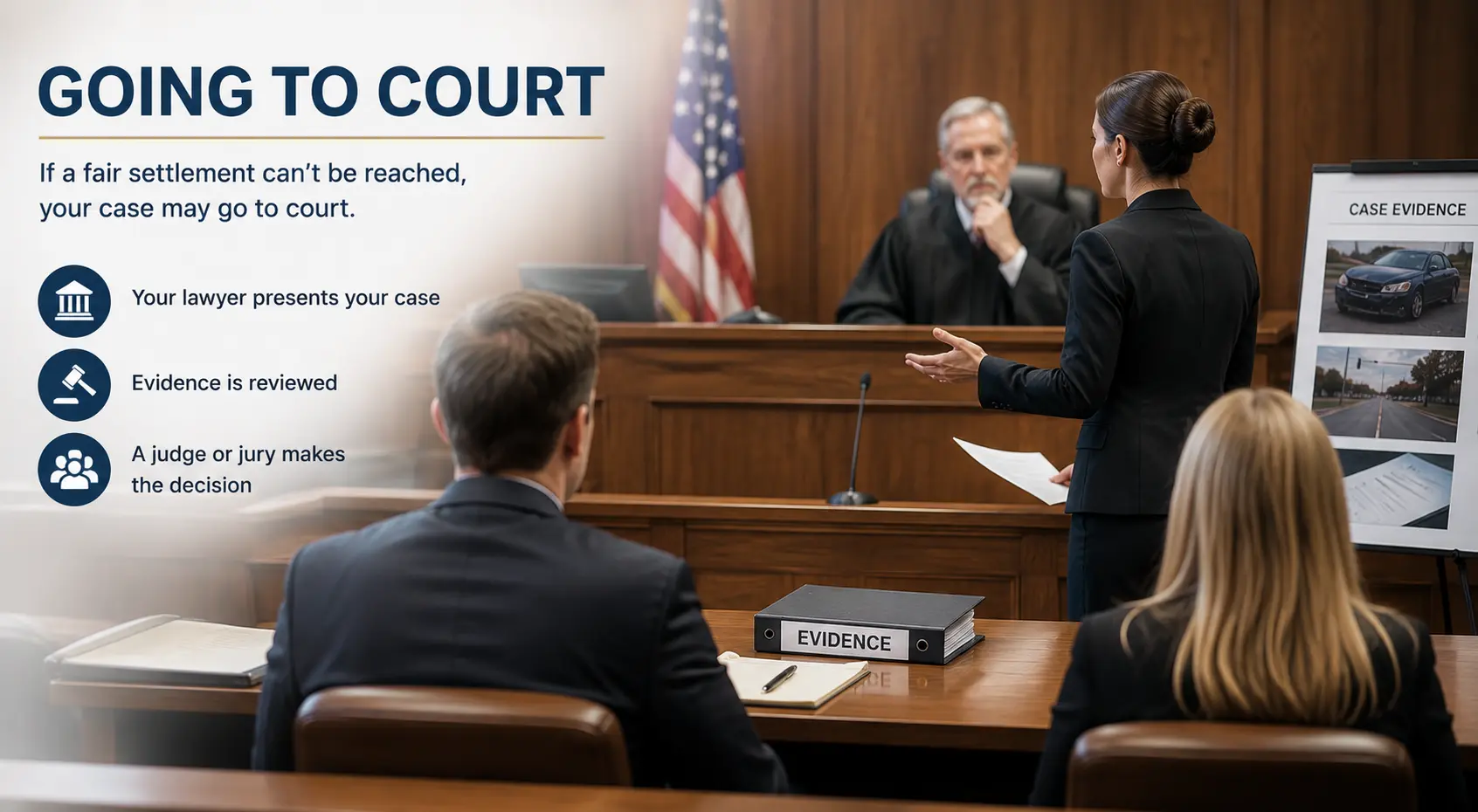
Most car accident claims are resolved through insurance negotiations, but not every case ends with a settlement. When the parties cannot agree on fault, compensation, or other important issues, filing a lawsuit may become an option. Going to court does not guarantee that a trial will occur. In fact, many lawsuits are settled before reaching a courtroom.
Understanding what happens during the litigation process can help reduce uncertainty if a claim moves beyond the insurance stage.
When Does a Lawsuit Become Necessary?
A lawsuit may be considered when:
- The insurance company denies the claim.
- The settlement offer does not reasonably address the documented losses.
- There is a serious dispute over who caused the accident.
- The injuries involve substantial long-term damages.
- Multiple parties disagree about liability.
Before filing a lawsuit, it is important to understand the statute of limitations , which is the legal deadline for bringing a claim. These deadlines vary by state, and missing one may prevent you from pursuing the claim in court.
The Civil Court Process
Although procedures differ by jurisdiction, many car accident lawsuits follow a similar sequence.
| Stage | What Happens |
|---|---|
| Filing the Complaint | The plaintiff files legal documents explaining the claim and the relief being sought. |
| Defendant's Response | The defendant files an official response to the complaint. |
| Discovery | The parties exchange relevant information, documents, and evidence. |
| Depositions | Parties and witnesses may answer questions under oath. |
| Settlement Discussions | Negotiations may continue throughout the case. |
| Trial | A judge or jury determines the issues that remain unresolved if no settlement is reached. |
The discovery phase can be one of the longest parts of the process because each side gathers and reviews evidence before trial.
What Evidence Is Used in Court?
Many of the documents collected during the insurance claim may remain important if litigation begins.
Examples include:
- Medical records
- Accident reports
- Photographs and videos
- Witness testimony
- Expert opinions
- Vehicle repair records
- Employment and wage documentation
Additional expert witnesses, such as accident reconstruction specialists or medical professionals, may also testify in more complex cases.
What Happens at Trial?
During a trial, each side presents evidence and questions witnesses. The judge oversees the proceedings, while a jury determines the facts in cases where a jury trial is used.
The court may determine:
- Who was legally responsible for the accident
- Whether the plaintiff proved their claimed damages
- The amount of compensation, if any
- Whether applicable state negligence rules affect the award
Trials can last from a single day to several weeks or longer, depending on the complexity of the case.
Appeals
After a trial, either party may have the right to appeal under certain circumstances. An appeal is not a new trial. Instead, a higher court reviews whether legal errors may have affected the outcome.
Because appeals involve strict procedural requirements and deadlines, they differ significantly from the original lawsuit.
Practical Example
Suppose an insurance company argues that a driver's back injury existed before the accident and refuses to offer additional compensation. After settlement negotiations fail, the injured driver files a lawsuit. During discovery, updated medical records and expert testimony help clarify how the collision affected the driver's condition. Before trial begins, the parties reach a settlement based on the additional evidence.
While many claims never reach court, understanding the litigation process can help you prepare if negotiations do not resolve the dispute. If your claim involves significant injuries, disputed liability, or complex legal issues, consulting a car accident lawyer can help you understand the court procedures that apply in your state.
Statute of Limitations and Important Deadlines
Meeting legal and insurance deadlines is an important part of protecting a car accident claim . Missing a required deadline can delay your claim or, in some situations, prevent you from recovering compensation altogether. Different deadlines may apply depending on the type of claim, the parties involved, and the state where the accident occurred.
Because these time limits vary across the United States, it is important to understand which deadlines apply to your situation.
What Is the Statute of Limitations?
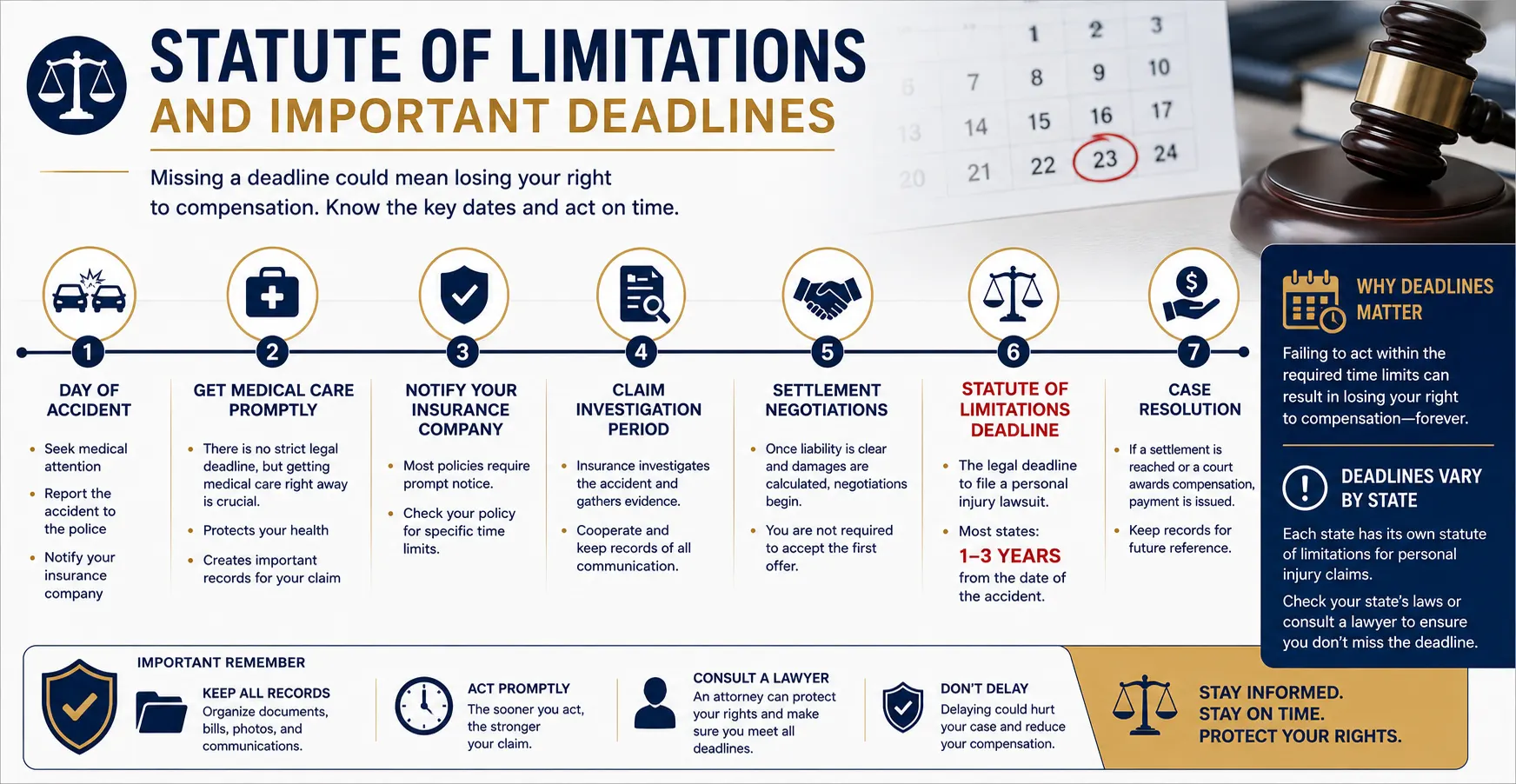
A statute of limitations is a legal deadline for filing a lawsuit after a car accident. If you do not file your case before the applicable deadline expires, a court may dismiss the claim, subject to any exceptions provided by state law.
The length of the statute of limitations differs by state. Different deadlines may also apply to:
- Personal injury claims
- Property damage claims
- Wrongful death claims
- Claims involving government entities
Because these deadlines are established by state law, always verify the requirements that apply where the accident occurred.
Insurance Deadlines vs. Legal Deadlines
Insurance companies may require accidents to be reported promptly, but these reporting requirements are not the same as the statute of limitations.
The table below highlights the difference:
| Deadline | Purpose |
|---|---|
| Insurance Reporting Deadline | Requires the policyholder to notify the insurance company of the accident, usually within the time required by the policy. |
| Statute of Limitations | Sets the legal deadline for filing a lawsuit in court, subject to applicable state law and exceptions. |
Meeting one deadline does not automatically satisfy the other. For example, reporting an accident to your insurer on time does not necessarily extend the deadline for filing a lawsuit.
Situations That May Affect Filing Deadlines
Although statutes of limitations are generally strict, certain circumstances may affect how they apply. Depending on state law, exceptions or special rules may exist for situations involving:
- Minors
- Individuals with certain legal disabilities
- Delayed discovery of an injury
- Claims against government entities
- Wrongful death actions
Some claims against government entities may require notice within a much shorter period than ordinary personal injury claims. Because these rules can be complex, it is important to review the applicable requirements as early as possible.
Why Acting Early Matters
Even if the legal deadline is months or years away, waiting too long can make a claim more difficult to prove.
Over time:
- Witness memories may fade.
- Surveillance footage may be deleted.
- Physical evidence can disappear.
- Medical records and treatment documentation may become harder to organize.
- Repair records and receipts may be misplaced.
Taking action promptly helps preserve evidence and gives you more time to organize documentation and respond to insurance or legal requirements.
Practical Example
Imagine a driver waits several years before deciding to file a lawsuit after settlement negotiations break down. Although the accident and injuries are well documented, the state's statute of limitations has already expired. If no exception or other rule applies, the court may dismiss the lawsuit, regardless of the strength of the evidence.
Understanding the deadlines that apply to your claim is just as important as collecting evidence or documenting your losses. If you are uncertain about the filing deadlines in your state or your claim involves unusual circumstances, consider consulting a qualified attorney before an important legal deadline passes.
Common Mistakes and How to Protect Your Claim
Even a strong car accident claim can become more difficult if important mistakes are made after the accident or during the claims process. Some errors can delay a decision, create disputes with an insurance company, or make it harder to document losses.
Many of these problems are avoidable with careful documentation, timely communication, and a clear understanding of your responsibilities.
Waiting Too Long to Take Action
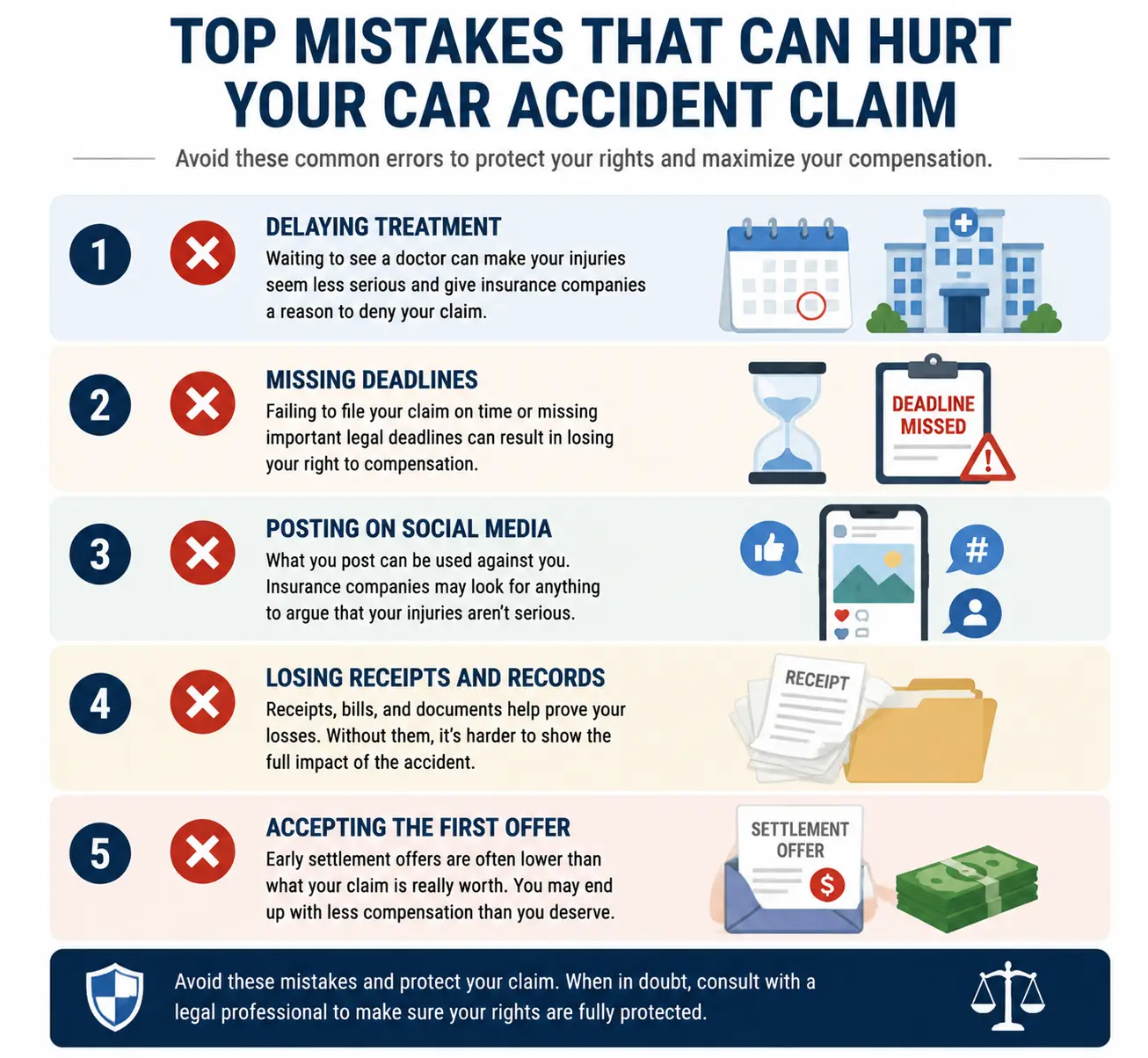
One of the most common mistakes is delaying important steps after an accident.
Examples include:
- Waiting too long to report the accident to your insurer.
- Delaying medical evaluation or treatment without a reasonable explanation.
- Missing deadlines for submitting requested documents.
- Filing a lawsuit after the applicable statute of limitations has expired.
Taking prompt action can help preserve evidence and reduce avoidable problems during the claims process.
Failing to Keep Records
Insurance companies rely heavily on documentation when evaluating claims. Missing records can make it harder to verify your losses.
Consider keeping copies of:
- Medical bills and treatment records
- Prescription receipts
- Vehicle repair estimates
- Insurance correspondence
- Photos and videos of the accident
- Wage statements showing missed work
- Notes from conversations with adjusters
Organizing these documents in one location can make responding to requests much easier.
Providing Inaccurate or Incomplete Information
Always provide truthful and accurate information when communicating with insurers, healthcare providers, or legal professionals.
Avoid:
- Guessing about facts you do not remember.
- Exaggerating injuries or vehicle damage.
- Omitting relevant information.
- Signing documents without reviewing them carefully.
Consistency across medical records, insurance forms, and other documents can help prevent unnecessary questions about your claim.
Ignoring Medical Advice
Following your healthcare provider's treatment recommendations is important for your health and can also help maintain clear records of your treatment.
Missing appointments, stopping treatment without explanation, or failing to follow medical instructions may lead an insurer to question whether the accident caused the full extent of your claimed injuries.
If your treatment changes for legitimate reasons, keep records explaining why.
Accepting the First Settlement Too Quickly
An early settlement offer is not necessarily the final offer. Before accepting any agreement, make sure you understand:
- Whether all medical treatment has been considered.
- Whether future expenses may still arise.
- Whether property damage has been fully evaluated.
- Whether accepting the offer requires releasing future claims.
Reviewing the terms carefully can help prevent unexpected financial problems later.
Posting About the Accident on Social Media
Photos, comments, or videos shared online may become relevant during a claim.
To help protect your claim:
- Avoid discussing the accident publicly.
- Do not post updates about injuries or settlement negotiations.
- Review your privacy settings, recognizing that they may not completely prevent information from being shared.
Even posts unrelated to the accident can sometimes be misunderstood without proper context.
Practical Claim Protection Checklist
Use this checklist throughout the claims process:
✓ Report the accident promptly.
✓ Keep copies of every accident-related document.
✓ Attend scheduled medical appointments.
✓ Save receipts for accident-related expenses.
✓ Respond to reasonable insurance requests on time.
✓ Review settlement documents carefully before signing.
✓ Avoid discussing your claim on social media.
✓ Consult a car accident lawyer if significant disputes or legal questions arise.
Practical Example
Imagine an injured driver accepts a settlement shortly after the accident, believing their injuries are minor. Several weeks later, additional medical treatment becomes necessary. Because the settlement agreement included a full release of future claims, recovering additional compensation may no longer be possible. Carefully reviewing settlement terms before signing can help avoid situations like this.
Protecting a claim is often less about taking extraordinary steps and more about consistently making informed decisions throughout the process. Careful recordkeeping, honest communication, and attention to deadlines can help you avoid preventable problems from the beginning of the claim through its resolution.
Hiring a Car Accident Lawyer
Many car accident claims are resolved without going to court or requiring ongoing legal representation. However, some situations are more complicated and may benefit from professional legal guidance. Understanding when a car accident lawyer may be helpful allows you to make an informed decision based on the facts of your claim.
Hiring a lawyer does not automatically mean a case will end up in court. In many cases, attorneys may assist with investigating the accident, communicating with insurance companies, gathering evidence, and negotiating settlements.
When You May Want to Consult a Lawyer
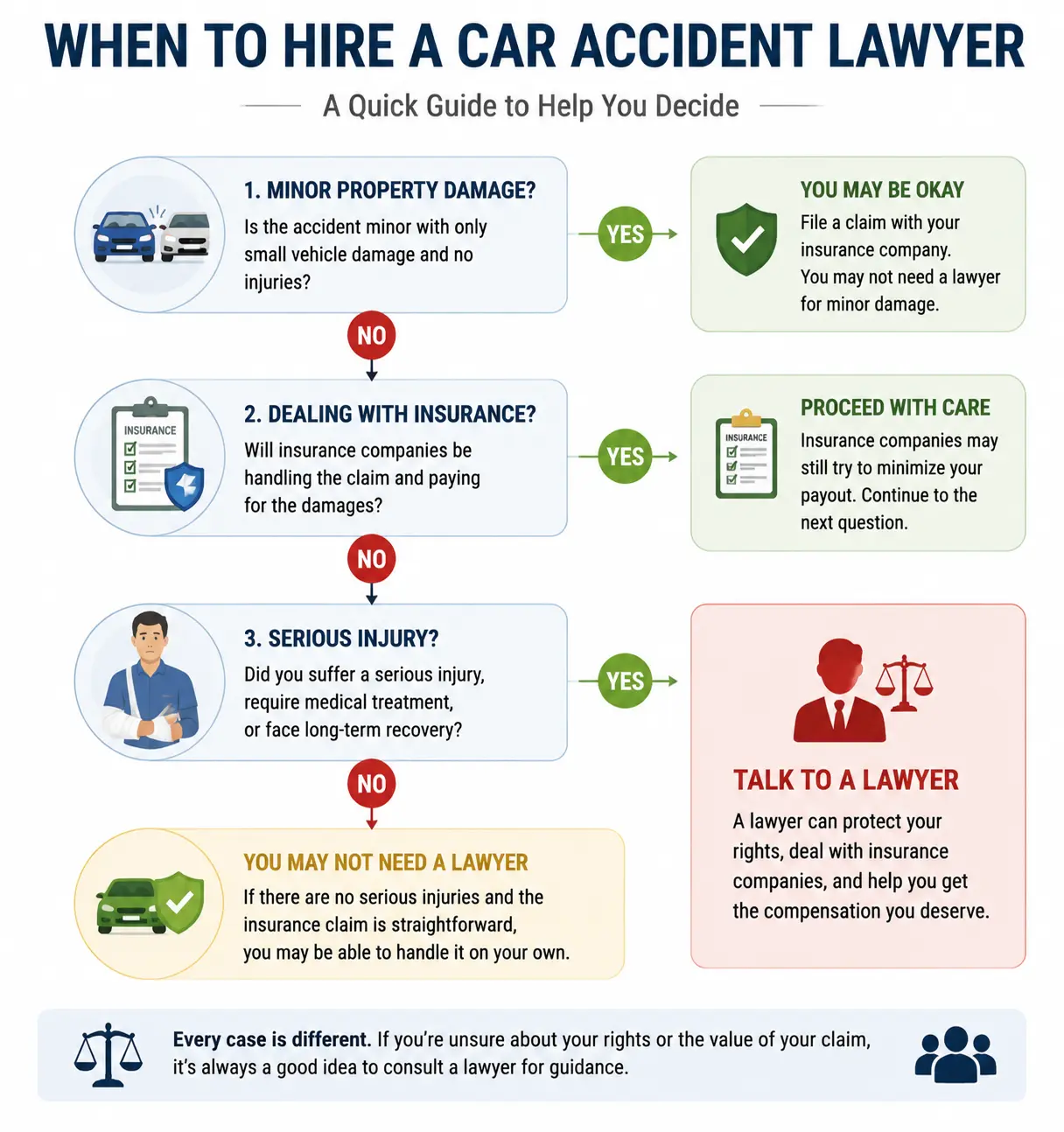
Legal guidance may be appropriate if:
- You suffered serious or permanent injuries.
- Liability is disputed.
- Multiple vehicles or parties were involved.
- The insurance company denied your claim.
- The settlement offer does not appear to reflect your documented losses.
- A commercial truck, government vehicle, or defective vehicle may be involved.
- A lawsuit has been filed or is being considered.
Even if you are unsure whether you need legal representation, an initial consultation may help you understand your options under your state's laws.
What Does a Car Accident Lawyer Do?
A lawyer's responsibilities vary depending on the complexity of the case but may include:
- Reviewing the facts of the accident
- Identifying potentially responsible parties
- Collecting medical records and other evidence
- Working with accident reconstruction or medical experts when necessary
- Communicating with insurance adjusters
- Negotiating settlement offers
- Filing legal documents within required deadlines
- Representing the client during litigation if the case proceeds to court
The lawyer's role may include handling legal and insurance-related matters while the injured person focuses on recovery.
Questions to Ask Before Hiring a Lawyer
Choosing legal representation is an important decision. During an initial consultation, consider asking questions such as:
- How much experience do you have with car accident cases?
- Who will handle my case on a day-to-day basis?
- How will you communicate case updates?
- What documents should I provide?
- How are legal fees and expenses handled?
- What should I expect during the claims process?
These questions can help you understand how the attorney works and whether their approach meets your needs.
Understanding Contingency Fees
Many personal injury lawyers work on a contingency fee basis. This generally means the attorney's fee is based on a percentage of the amount recovered, although the specific arrangement depends on the lawyer and fee agreement.
The exact percentage, litigation costs, and payment arrangements vary by law firm. These terms should be explained clearly in a written fee agreement before representation begins.
Practical Example
Suppose a driver suffers significant injuries in a crash involving a commercial delivery vehicle. Several insurance companies become involved, liability is disputed, and medical treatment continues for months. Because multiple parties and complex legal issues are involved, the driver decides to consult a car accident lawyer to better understand the available legal options and manage the claim.
Choosing the Right Lawyer
If you decide to hire an attorney, take time to evaluate your options rather than making a decision based solely on advertising.
Consider factors such as:
- Relevant experience
- Clear communication
- Professional reputation
- Responsiveness
- Transparency regarding fees and the claims process
Selecting a lawyer who explains legal issues clearly and keeps you informed throughout the case can make the process easier to understand.
Hiring a lawyer is a personal decision that depends on the complexity of the claim and the circumstances involved. For straightforward claims, insurance negotiations may be sufficient. For more complicated disputes, professional legal guidance may help clarify your rights and responsibilities under applicable state law.
Frequently Asked Questions
1. What documents should I keep after a car accident?
Keep copies of medical records, repair estimates, police reports, insurance correspondence, receipts, photos, and witness information until your claim is fully resolved.
2. Can passengers file a car accident claim?
Yes. An injured passenger may be able to file a claim against an applicable insurance policy, depending on who was responsible for the accident and the coverage available.
3. What happens if my car is declared a total loss?
If an insurer determines that your vehicle is a total loss, the amount paid may generally be based on the vehicle's actual cash value (ACV), subject to the applicable policy, coverage limits, deductible, and state law.
4. Can I recover the cost of a rental car?
Possibly. Rental expenses may be covered by your own insurance policy or the at-fault driver's insurer, depending on the coverage and circumstances.
5. Are car accident settlements taxable?
Some amounts received for personal physical injuries may receive favorable tax treatment, but the tax treatment can depend on what the settlement compensates you for and other circumstances. Consider consulting a qualified tax professional about your specific situation.
6. Can I reopen my claim after accepting a settlement?
Usually, settling a claim involves signing a release that limits or ends your ability to pursue additional compensation for the same accident. Review the settlement and release carefully before signing.
7. Will my insurance premium increase after a car accident?
It depends on factors such as your insurer, the circumstances of the accident, your driving history, your state, and whether you were found responsible.
8. Can I change lawyers during my car accident case?
In many situations, you may be able to change attorneys. However, review your representation agreement first because fees, case expenses, and other obligations may need to be addressed.
9. How long should I keep accident-related records?
Keep accident-related records until your claim is fully resolved and any applicable legal deadlines have passed. If litigation is involved, additional record-retention requirements may apply.
10. What should I do if the insurance company requests more information?
Provide accurate information and reasonable documentation within the applicable timeframe. Keep copies of everything you submit and make a record of important communications with the insurer.
11. Can I file a claim if the accident happened during bad weather?
Yes. Bad weather does not automatically prevent someone from making a claim. However, insurers may consider road conditions, visibility, vehicle speed, and whether any driver acted negligently when evaluating responsibility.
12. Can I file a claim if the accident involved a rideshare vehicle?
Possibly. Accidents involving rideshare vehicles can involve additional insurance coverage depending on whether the driver was logged into the rideshare app, waiting for a passenger, or transporting a passenger when the accident occurred. State law and the applicable insurance policies also matter.
13. What if the at-fault driver left the state?
Moving to another state does not necessarily prevent you from pursuing a claim. The applicable insurance policy, jurisdiction, and state laws will determine how the claim or lawsuit may proceed.
14. Can I recover lost wages after a car accident?
Potentially. Lost wages may be recoverable when an accident-related injury prevents you from working, subject to applicable insurance coverage and state law. Documentation such as pay stubs, employer records, or tax documents may help support the claim.
15. Should I repair my vehicle before the claim is settled?
Before making significant repairs, check with the relevant insurer about its inspection and documentation requirements. Keep photographs, repair estimates, invoices, and other records showing the vehicle's condition and repair costs.
16. What is the statute of limitations for a car accident claim?
The statute of limitations is the legal deadline for filing a lawsuit after a car accident. The deadline varies by state, the type of claim, and sometimes the parties involved.
17. Can the statute of limitations be extended?
Sometimes. Certain legal exceptions may affect when the deadline begins or how long it applies, depending on state law and the circumstances of the claim.
18. Is the deadline different for property damage claims?
It can be. Some states have different filing deadlines for property damage and personal injury claims. The applicable deadline depends on state law.
19. What happens if I miss the filing deadline?
If the applicable statute of limitations expires, a court may dismiss the lawsuit, subject to any exceptions or other rules provided by state law.
20. Do insurance claim deadlines and lawsuit deadlines differ?
Yes. An insurance policy may require prompt notice of an accident, while the statute of limitations establishes the legal deadline for filing a lawsuit. These are separate requirements.
Final Checklist & Key Takeaways
By this point, you should have a clear understanding of how a car accident claim generally works—from the steps to take immediately after a collision to understanding insurance coverage, compensation, and when legal guidance may be appropriate.
Although accidents and claims can differ, staying organized and making informed decisions can help you navigate the claims process more effectively. Because insurance rules, filing deadlines, and liability laws vary by state, always confirm the requirements that apply where your accident occurred.
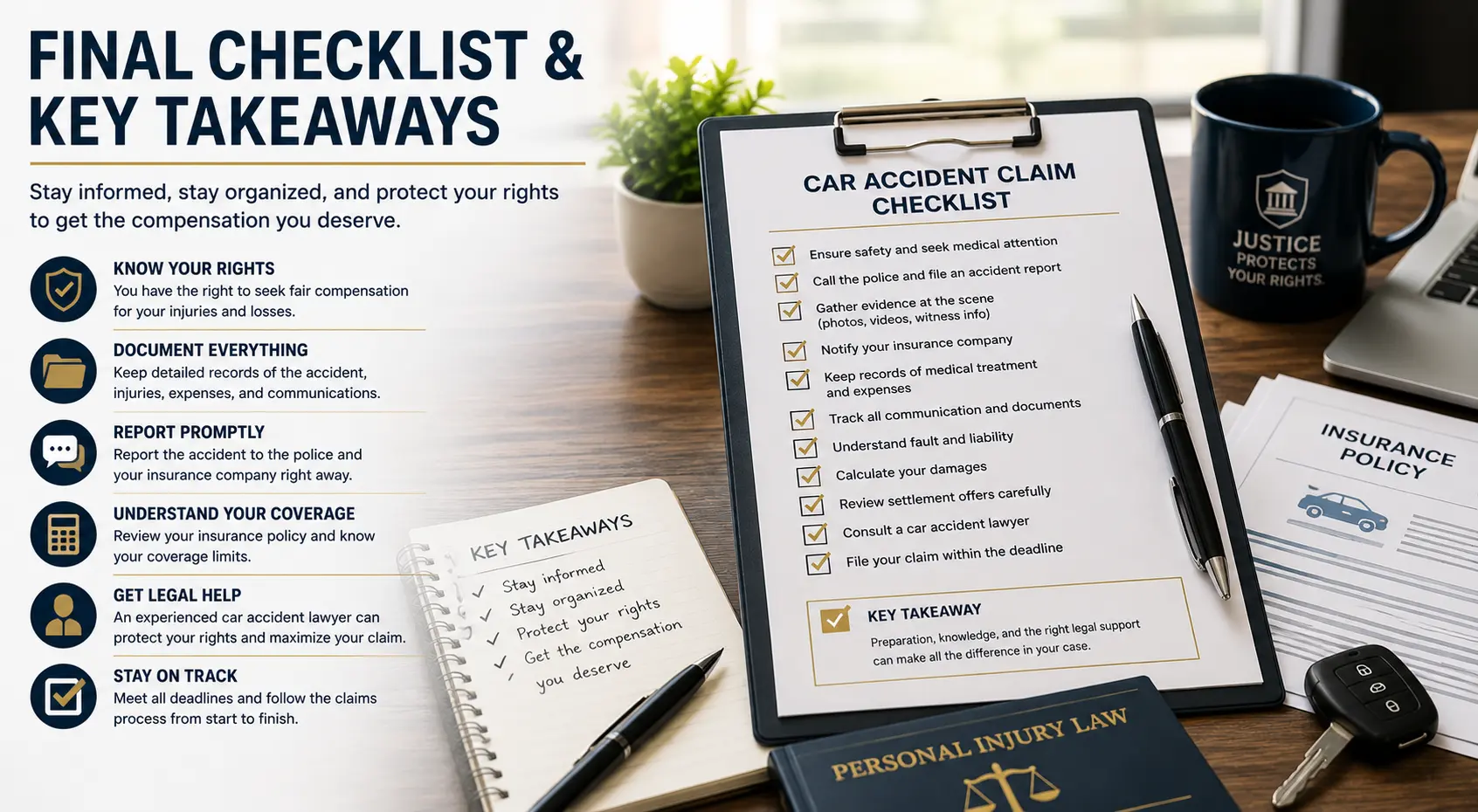
Car Accident Claim Checklist
Use this checklist as a quick reference throughout the claims process.
Immediately After the Accident
✓ Check for injuries and call emergency services if needed.
✓ Move to a safe location when possible.
✓ Contact law enforcement when required or appropriate.
✓ Exchange contact and insurance information.
✓ Take photographs and videos of the accident scene.
✓ Obtain witness contact information.
During the Insurance Claim
✓ Report the accident to the appropriate insurance company promptly.
✓ Keep copies of all claim-related documents.
✓ Save medical bills, repair estimates, receipts, and correspondence.
✓ Track accident-related expenses in one organized file.
✓ Respond to reasonable requests from your insurer on time.
During Medical Recovery
✓ Follow your healthcare provider's treatment plan.
✓ Attend scheduled appointments.
✓ Keep records of medications, therapy, and follow-up care.
✓ Document how your injuries affect daily activities, when appropriate.
Before Accepting a Settlement
✓ Review the settlement carefully.
✓ Confirm that all known losses have been considered.
✓ Understand whether the agreement releases future claims.
✓ Ask questions if any terms are unclear.
If Your Claim Becomes More Complex
✓ Review applicable state laws and filing deadlines.
✓ Preserve relevant evidence and records.
✓ Consider consulting a car accident lawyer if liability, damages, or legal procedures become disputed.
Key Lessons From This Guide
The claims process is easier to understand when it is viewed as a series of connected steps rather than one large legal issue. Building a well-documented claim, understanding your insurance coverage, recognizing how fault can affect compensation, and meeting important deadlines can all help you navigate the process more effectively.
Not every claim follows the same path. Some are resolved through insurance negotiations, while others involve multiple parties, complex evidence, or court proceedings. Staying informed and organized can help you respond more effectively as your claim progresses.
Finally, this guide provides general educational information about car accident claims in the United States. It is not legal advice. If your situation involves serious injuries, disputed liability, or questions about your legal rights, consider seeking guidance from a qualified attorney familiar with the laws of your state.
Written by: Top 10 Accident Lawyers Editorial Team
Published: August 7, 2026
Legal Disclaimer: This article is for informational purposes only and is not legal advice. Consult a qualified attorney for legal guidance.
Comments